What Separates a Fundamentally Strong Token from a Pump-and-Dump Scheme
Most tokens launch with no vesting, no revenue model, and no real utility. Here are the 3 tokenomics pillars that fundamentally strong Web3 projects build on -- and the red flags that reveal a project is designed to fail.
Ashish Homkar
Founder & CEO · March 17, 2026 · 6 min read
Tokenomics is the cornerstone of every credible Web3 project. It is not a whitepaper section you fill in after the product is built -- it is the architecture that determines whether your token creates genuine value or exists purely to be sold to the next buyer.
The Web3 space is saturated with projects that launch 10 billion tokens, spend heavily on influencer marketing, and have no underlying economic model to sustain any of it. No vesting schedules. No revenue linked to token mechanics. No liquidity strategy.
The 3 Pillars of Fundamentally Strong Tokenomics
Pillar 1
Pillar 2
Pillar 3
Value accrual and utility
Community alignment and governance
Sustainable supply and scalability
Token demand is driven by staking, governance, access, or transaction facilitation, not speculation alone. Mechanisms like token burning or revenue sharing create structural reasons to hold.
Fair distribution with vesting schedules for teams and investors prevents market manipulation. DAO structures empower holders and align incentives between builders and community.
Supply and inflation mechanics are designed for the long term, balancing growth with scarcity. The model scales with user adoption and is verified through security audits.
Pillar 1 -- Value Accrual and Utility
A token without utility is a coupon with an expiry date someone forgot to print. Every token must have a clear, structural reason for people to acquire and hold it -- not just a narrative reason.
The strongest utility mechanisms embed the token into core product interactions: staking to access platform features, governance rights that carry real weight in protocol decisions, transaction fee requirements that create persistent buy pressure, or revenue-sharing models that make holding the token financially rational beyond price appreciation alone.
The question to ask at design stage: if the token price dropped 80% tomorrow, would users still have a reason to hold it? If the answer is no, the utility design is not sufficient.
Pillar 2 -- Community Alignment and Governance
Token distribution is one of the most scrutinised elements of any project, and for good reason. When teams and early investors hold large, unlocked allocations, the incentive structure is misaligned from day one.
Vesting schedules correct this. When team and investor allocations unlock gradually, tied to time or performance milestones, it signals that insiders are committed to long-term value creation, not an exit.
What good distribution design looks like:
Team and investor allocations with cliff periods of 6 to 18 months before any unlock begins
Linear or milestone-based vesting over 2 to 4 years post-cliff
Community and ecosystem allocations that are structurally larger than private allocations
Public visibility of all wallet allocations and vesting schedules on-chain
Pillar 3 -- Sustainable Supply and Scalability
Supply mechanics must be modelled against adoption scenarios. What does circulating supply look like at 10,000 users? At 1 million? How do staking rewards interact with emission schedules? What is the inflation rate in year three and how does that compare to projected demand growth?
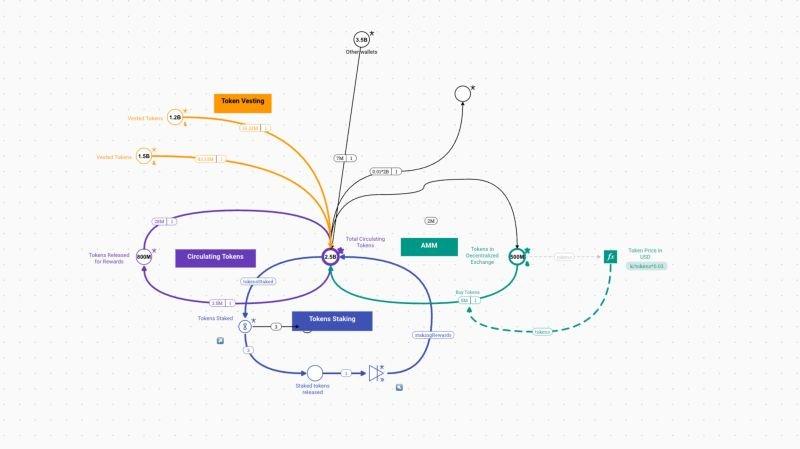
Tokenomics audits using tools like Machinations.io to model dynamic systems before they go live are underutilised but enormously valuable. They allow you to stress-test your economic model under different market conditions before a single token is minted.
Tokenomics modelling tools like Machinations.io let you simulate vesting flows, staking dynamics, and circulating supply across time, catching structural weaknesses before they become irreversible on-chain problems.
Red Flags That Reveal a Project Is Designed to Fail
Watch for these warning signs in any project you are evaluating or building:
No vesting schedules: team and investor tokens are fully liquid at launch, creating immediate sell pressure.
No revenue model linked to tokenomics: the token exists separately from how the business generates or distributes value.
Staking with no demand basis: APY funded by inflation rather than genuine protocol revenue.
No market-making strategy at listing: launching without a liquidity plan means the token price collapses on first sell pressure.
Marketing-first, tokenomics-never: heavy influencer spend before any economic model is finalised.
The most dangerous rug pull is not always intentional. Many founders build broken tokenomics without realising it -- then watch the project collapse and blame the market.
Frequently Asked Questions
What are the most important elements of strong tokenomics?
The three foundational pillars are: genuine utility that drives structural token demand, fair distribution with vesting schedules that align team and investor incentives with long-term value, and a sustainable supply model with inflation mechanics calibrated to adoption growth.
What is token vesting and why does it matter?
Token vesting is a schedule that unlocks allocated tokens gradually over time rather than all at once at launch. It matters because it prevents team members and early investors from selling large quantities immediately after launch.
How do you model tokenomics before a token launches?
Tokenomics modelling tools like Machinations.io allow teams to simulate circulating supply, staking flows, vesting unlocks, and emission schedules dynamically before the token is deployed.
What is the difference between a legitimate staking programme and an inflationary one?
A legitimate staking programme funds rewards from genuine protocol revenue. An inflationary staking programme funds rewards by minting new tokens, which dilutes existing holders and creates artificial yield.
What does a tokenomics audit involve?
A tokenomics audit reviews the economic model of a token covering supply mechanics, emission schedules, vesting design, utility drivers, liquidity allocation, and inflation projections to identify vulnerabilities before launch.