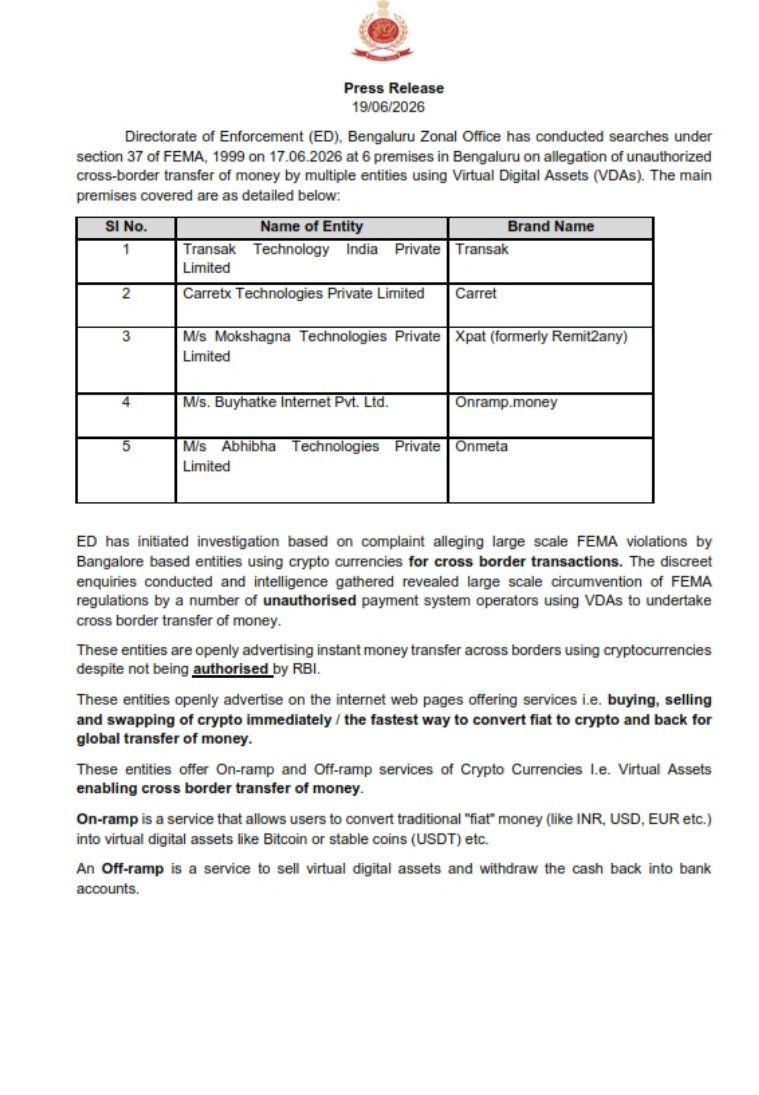
ED raided five crypto firms in Bengaluru for "unauthorised cross-border transfer of money via cryptocurrencies." i.e., FEMA Guidelines but these aren't scams.
Blockphrase Team
Admin · June 26, 2026 · 5 min read
ED raided five crypto firms in Bengaluru for "unauthorised cross-border transfer of money via cryptocurrencies." i.e., FEMA Guidelines but these aren't scams.
They're Web3 fintech firms trying to build legitimate cross-border crypto rails.
The ED's complaint: none were RBI-authorized for cross-border VDA transfers, and to be fair to all that authorization category doesn't exist yet.
The firms aren't the gap. The framework is that there is no clear legal path these firms could have followed.
They could register under PMLA - a reporting obligation, not an authorization.
They could move to GIFT City, where the rules are still ambiguous for pure crypto.
They could apply to be RBI Authorized Dealers - except no AD category exists for VDA settlement.
They could enter the RBI Sandbox, except that VDAs are excluded from every cohort to date.
This isn't a critique of the ED's mandate. Enforcement of money laundering laws is essential, and the agency has done real work breaking up real fraud like OctaFX, HPZ, and the 26-website syndicate that was scamming customers.
The question is :
When firms are trying to be compliant, but no compliance path exists, what's the right response?
In every other jurisdiction taking digital assets seriously, the answer is: A sandbox.
India already runs sandboxes, but none currently accept VDA applications.
A VDA-inclusive sandbox would let firms operate under defined conditions such as capped volumes, mandatory KYC, real-time FIU reporting, escrow on user funds, and a clear path to full licensing.
Users get protected & the firms get a compliance route while reegulators get observable data and the innovation stays onshore.
Without it, every Indian VDA firm has three options:
→ Operate in the gray zone and risk enforcement (Not recommended) → Move offshore to Dubai, Singapore, BVI, or Abu Dhabi → Shut down
None of these protects Indian users.
A firm that moves to VARA doesn't stop serving Indians. It just stops being accountable to Indian regulators when something goes wrong. That's worse for everyone, including the regulators.
Singapore, the UAE, and Hong Kong all started where India is today - uncertain, cautious, enforcement-leaning.
They moved to licensed frameworks because the alternative was watching their fintech sector emigrate.
India has the largest user base, the deepest engineering talent, and the active regulators to do this better than any of them.
A VDA sandbox under RBI or IFSCA, even a limited one, would be the single most constructive step we can take.
Regulate and manage rather than enforce without clear regulation.